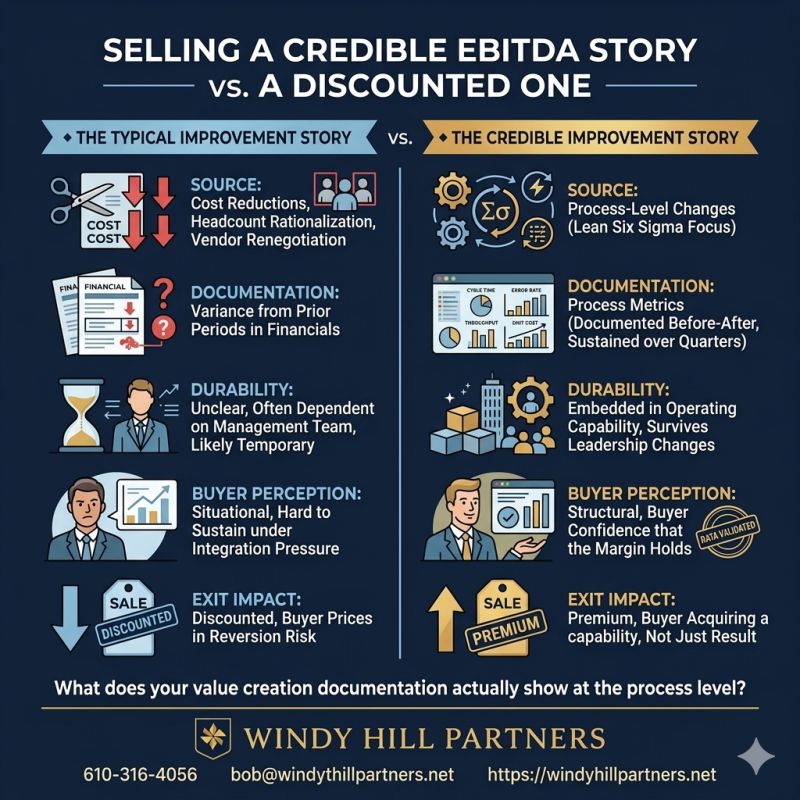
Not all EBITDA improvement stories land the same way. Buyers know the difference before the slide deck loads.
When sellers present value creation work, most buyers apply a discount before the conversation starts. The story sounds familiar because they’ve heard it before, and they’ve seen what happens to those numbers post-close.
Here’s what separates a credible story from a discounted one:
🔹 The typical improvement story
🔸 Source: Cost reductions, headcount rationalization, vendor renegotiation
🔸 Documentation: Variance from prior periods in the financials
🔸 Durability: Unclear, often dependent on the management team that made the cuts
🔸 Buyer perception: Situational, likely to soften under integration pressure 🔸 Exit impact: Discounted. Buyer prices in reversion risk.
🔷 The credible improvement story
✅ Source: Process-level changes with documented before-and-after metrics
✅ Documentation: Cycle time, error rate, throughput, labor cost per unit, sustained over multiple quarters
✅ Durability: Embedded in operating capability, survives leadership changes ✅ Buyer perception: Structural. The margin holds because the process holds. ✅ Exit impact: Premium. Buyer is acquiring a capability, not a result.
The difference is evidence.
A seller who can show process-level documentation, validated with data and sustained without the people who originally drove it, is selling a different asset. LSS creates exactly this kind of record: before-and-after metrics, capability built into the organization, a story a buyer can underwrite.
The multiple premium goes to the seller who can prove the margin is structural.
What does your value creation documentation actually show at the process level?
Talk it through. If this sounds like an operation in your portfolio or pipeline, book a free 30-minute working session.