Zero errors, 7 checkpoints
Last month was about the spreadsheet that ran hundreds of millions through one person. This month is about a process that looked like it was working fine.
I was reviewing an audit and reporting process at a bank. The goal was zero errors, and the unit was close. The error rate was low. By most measures, it worked.
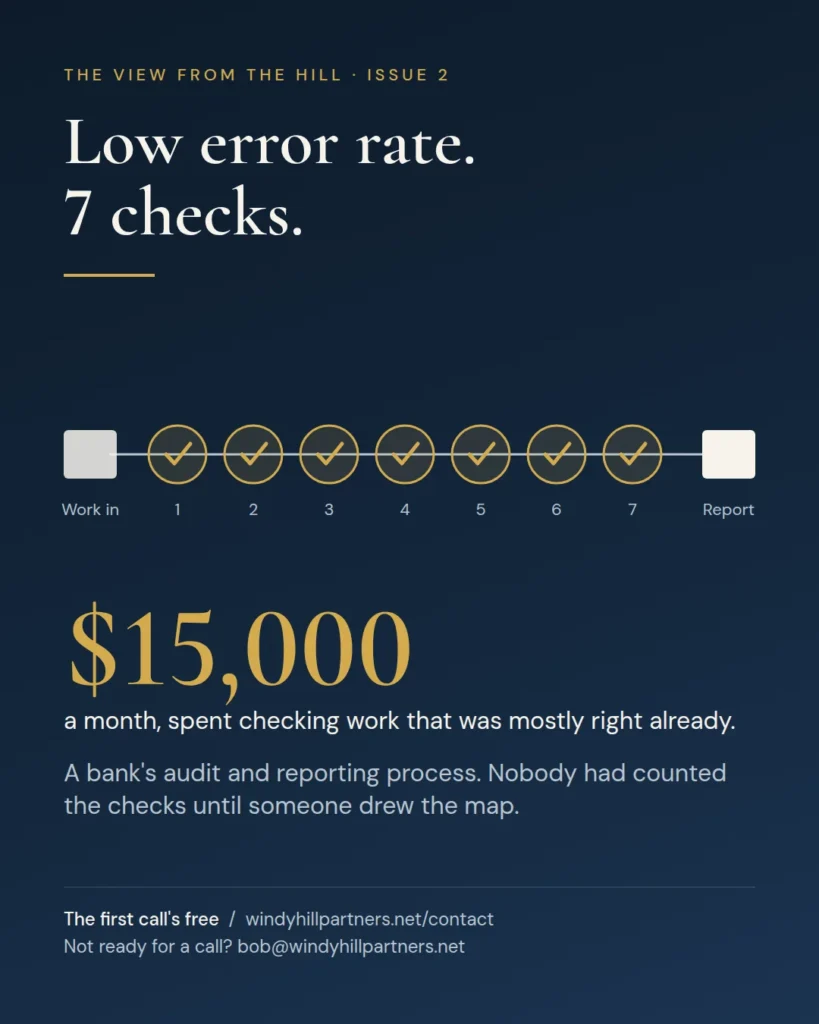
Then we mapped it, step by step, every handoff and every review. The map showed 7 separate quality checks between the start of the work and the report going out.
7 of them.
The unit’s first reaction was that this was fine. Maybe even good. Low errors and plenty of checking. That’s what careful looks like, right?
Then we put a dollar figure on it. Those 7 checks cost about $15,000 a month. That’s $180,000 a year spent confirming that work was right, most of which already was.
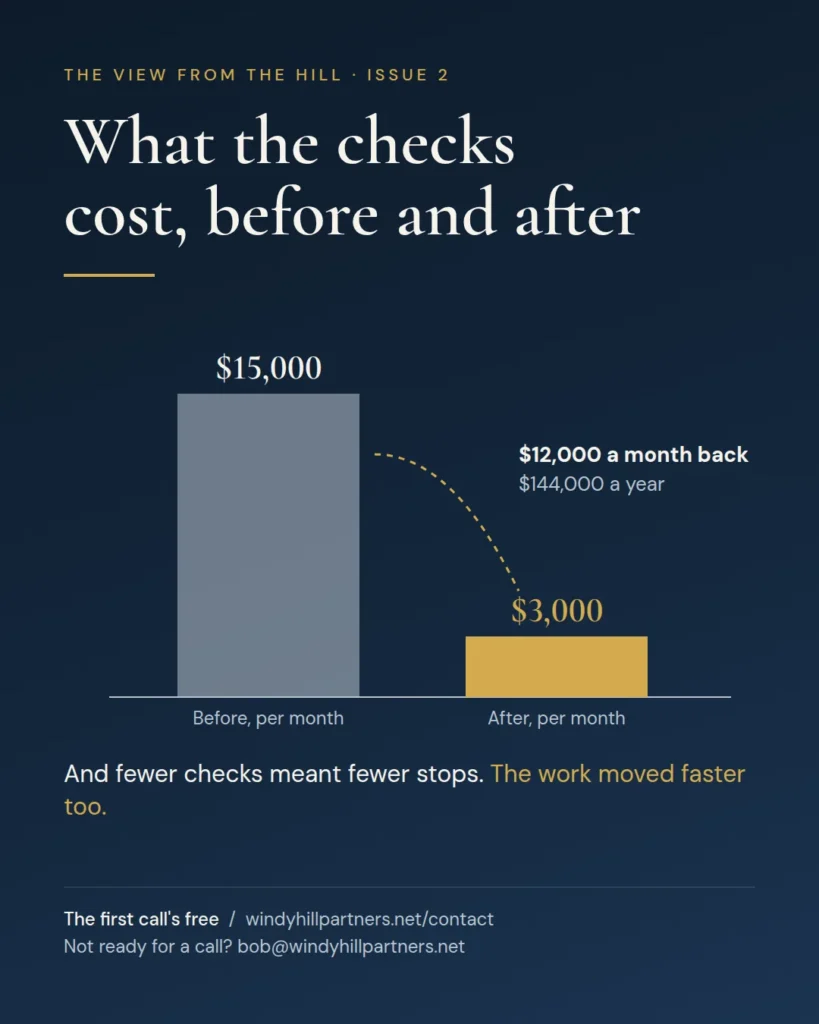
That changed the conversation. The unit redesigned the process, and the monthly cost of checking fell from $15,000 to about $3,000. That’s $12,000 a month saved, or $144,000 a year.
The bigger surprise was speed. With less checking, work stopped less often, and every stop had been a place where it sat in a queue waiting for someone’s review. Items moved through the process much faster, and the same team got more done. The checks hadn’t only cost money. They’d been slowing everything down.
Here’s what the map exposed. A low error rate tells you how many mistakes got out. It doesn’t tell you what you spent to keep them in. Each of those 7 checks cost time on every piece of work, whether that piece had a problem or not.
This isn’t a bank problem. It’s one of the most common things I find, in every kind of organization. Most don’t measure what poor quality costs them. Most can’t even tell you how many times a piece of work gets checked before it leaves the building.
Try it on your own operation. Pick one piece of work your team produces. How many times does someone review it before it goes out? If you had to stop and think, or the answer was “it depends,” you’re in good company. You’re also paying for checks nobody has counted.
Spend is not cost
It reminded me of a senior leadership training I once sat in, run by a professor from a top-tier business school. The professor told the organization’s finance lead, more or less, “You don’t know what each item costs.”
The finance lead pushed back. Take what we spend in a year, divide it by the number of items we produce, and there’s your cost per item.
The professor’s answer: “That’s spend per item. It isn’t cost.”
Spend per item tells you what you paid for. It doesn’t tell you what the work took. Hidden inside that average is every check on work that was already right, and every item made twice: the invoice reissued, the file sent back for a missing signature, the report corrected after it went out. Your average blends all of it in with the work done right the first time.
That’s the cost nobody budgets for. It isn’t on any line. It’s spread thin across every line.
Why the usual fixes fail
When margins slip, leadership reaches for the levers it can see. There are 3 favorites, and none of them touches work done twice.
Cut headcount. The budget says labor is the biggest line, so labor goes. But the rework doesn’t leave with the people. The same errors still come back, and now fewer hands are there to fix them. Queues grow, turnaround slips, and customers start to notice what used to stay inside the building.
Add a checker. Put a review step at the end to catch mistakes before they go out. It works, in the narrow sense that fewer errors escape. But the errors are still being made, now you’re paying someone to find them, and the checker becomes the new bottleneck. You’ve added a cost to hide a cost. The bank’s process had 7 of them.
Tell people to be more careful. A memo, a training session, a line in the performance review. Most rework isn’t carelessness. It’s a form that doesn’t ask for the right information, a handoff where nobody owns the missing piece, or an input that arrives wrong from upstream. Careful people make those errors too, because the process sets them up to.
All 3 treat the symptom they can see on the budget. The cause isn’t on the budget at all.
The view from the hill
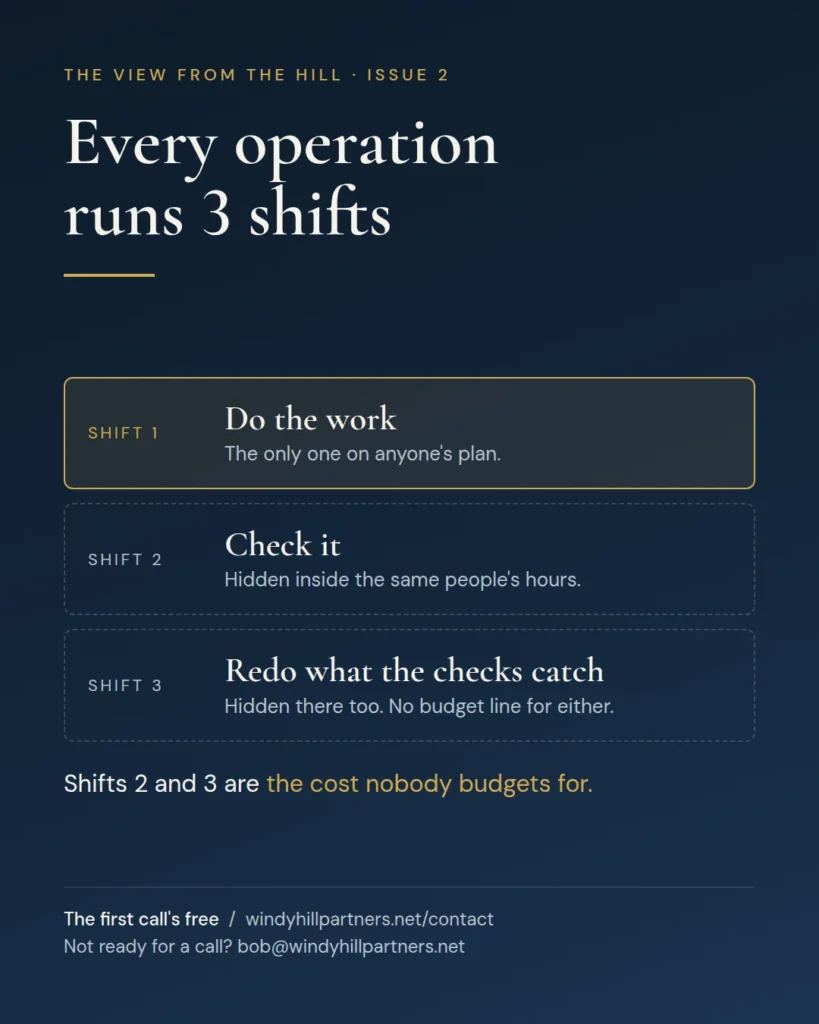
Every operation runs 3 shifts. The first does the work. The second checks it. The third redoes whatever the checks catch. Only the first one shows up on anyone’s plan. The other 2 are made of the same people, a few hours at a time.
Here’s a hypothetical to show the scale. Take a 40-person operations team with a fully loaded cost of $80,000 a head. Say 15% of their hours go to work that came back: fixing, re-sending, chasing, explaining. That’s 6 full-time people’s worth of time, or $480,000 a year, spent doing things a second time. And that’s before you count a single hour of checking.
Now add the errors that got out the door before anyone caught them. Those cost more than the hours to fix them. A credit issued, a penalty paid, a client who quietly takes the next project elsewhere. Those rarely get traced back to the original mistake at all.
The quality world has a name for this: the cost of poor quality. The CFO doesn’t need the name. The CFO needs 3 facts:
- It’s already in your budget. You aren’t going to find new money. You’re going to find money you’re already spending on the wrong thing.
- It doesn’t move when you cut. Cutting people removes capacity, not rework. The share of work that comes back stays the same or grows.
- It’s the cheapest money you’ll ever recover. Every item done right the first time is capacity you get back without hiring, and a customer who never had a reason to call.
Here’s the part most leaders skip. When a cost like this comes out, the reflex is to bank it. Think about spending it instead. The $144,000 a year from the bank’s checks is enough to fund a strong hire in many markets. Not another checker. Someone who prevents errors upstream, owns the process, and keeps looking for the next one. You’d be moving money from inspecting the work to getting it right the first time, and trading a cost that grows with volume for a person who gets more valuable every year they’re there.
That’s the opposite of the headcount cut from earlier. One takes capacity out and leaves the rework behind. The other takes the rework out and puts capacity back in.
The spreadsheet from last month is a textbook example. Every retyped cell was work done twice. So was every error someone had to track down later.
What to do Monday
You can’t manage a cost you’ve never counted. So count it, price it, and go after the biggest piece first.
1. Count what comes back, for 2 weeks. Pick one process. Give the team a simple tally: every time work comes back, write down what it was, why it came back, and roughly how long the fix took. Keep it to 3 columns and nobody will fight it. While you’re at it, count the checkpoints. The bank didn’t know it had 7 until someone drew the map. Don’t use it to grade anyone. The moment it turns into a blame log, people stop writing things down.
2. Put a dollar figure on it. Multiply the hours by your loaded rate. Add a rough cost for anything that reached a customer before it was caught. Then multiply by 26 to get a year. Ask the room to guess the number before you show it. The gap between the guess and the answer is the point of doing it.
3. Fix the top reason, not all of them. Sort the tally by reason. A few reasons will be doing most of the damage. Pick the top one and go after its cause: the form field that’s missing, the handoff nobody owns, the input that arrives wrong. Fix that one, run the tally again, and watch the number drop.
Then do it again. The goal isn’t one clean-up project with a consultant in the room. It’s a team that counts its own rework as a habit and knows how to knock the top reason down. That habit is worth more than any single fix, because the next source of rework is already on its way.
Price the work done twice
If you want a first number before you run a tally, our free calculator takes 6 inputs: how much work you handle, how much comes back, how long a fix takes, your loaded hourly rate, how many errors get out the door, and what each of those costs to clean up. It splits the answer into time spent redoing work and money lost to errors that escaped. It doesn’t count checking time, so if your process looks like the bank’s, add the review hours on top. Run it with your own numbers.
When the tally points at 1 process and you want a plan for it, that’s what the First Win Diagnostic is for: 1 process, 2 weeks, $7,500 fixed. You keep the ranked fix list and the 90-day plan. If you’re still sorting out which costs count, here’s cost of poor quality vs cost of quality in plain terms.
If the number makes you want to talk, I’d enjoy that. Tell me which process you’d count first and what you think you’ll find. Book a free call.
The View from the Hill comes out once a month. Bob Buckwalter is a Master Black Belt and the principal of Windy Hill Partners, a business transformation firm in the Philadelphia area that fixes processes and leaves your team able to keep fixing them.