The integration playbook most PE firms run is missing a chapter.
The financial model is there. So is the org chart and the 100-day synergy target. What’s missing is an operational baseline: a clear picture of how the acquired company actually works before anyone starts changing it.
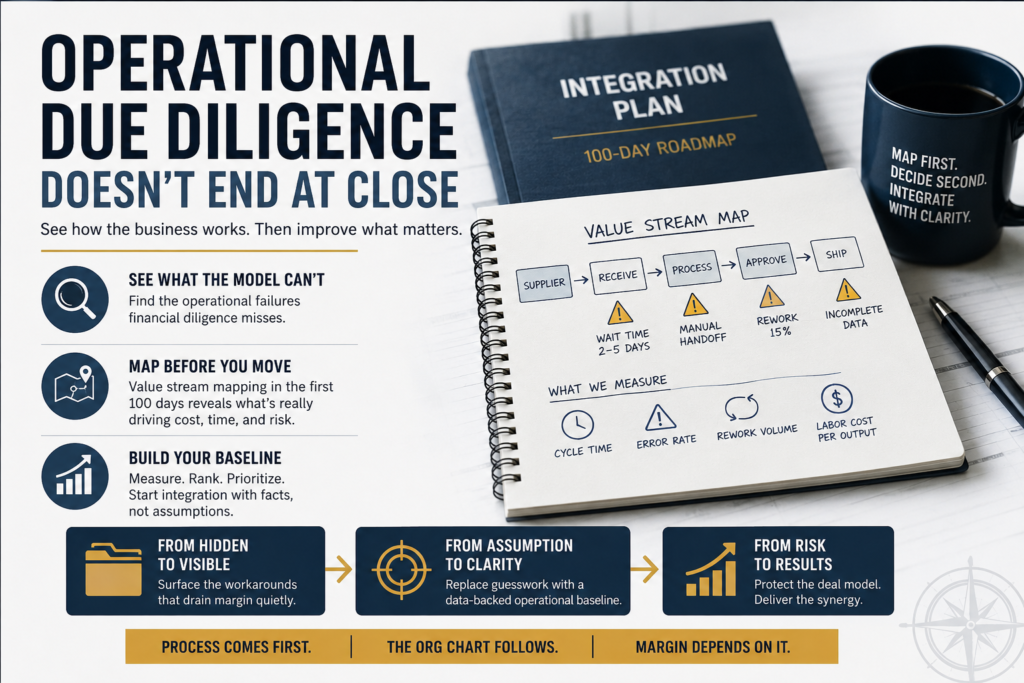
Why operational failures stay out of the data room
Financial diligence is thorough. Deal teams know the revenue to the decimal, they’ve stress-tested the debt, they’ve flagged every contingent liability. Then Day 1 arrives and nobody can answer a basic question: where does margin actually disappear in this business?
The answer is almost always in the processes. The manual workarounds that became permanent. The approval loops that add 5 days to a 2-hour task. The handoffs that exist on the org chart but break in practice.
Here’s what gets missed. A data room contains what the seller chose to document. And nobody documents their own workarounds, because writing one down means admitting it exists. The informality that makes a process fragile is the same thing that keeps it invisible during diligence. You don’t find these by reading. You find them by walking the work.
What a first-100-days operational baseline maps
Value stream mapping, done in the first 100 days before the org reshuffling starts, surfaces the three to five process failures doing the most damage. You measure that damage in cycle time, error rate, rework volume, and labor cost per unit of output.
You walk out with a ranked list of where to intervene. That’s a different starting point than a general sense that operations could be tighter.
Operational due diligence usually stops the day the check clears. That’s the wrong place to stop. The processes you inherit determine whether the synergy number in the model was real or aspirational.
Why the org chart is the wrong place to start
Most integration plans open by deciding who reports to whom. Reporting lines don’t fix broken workflows. They assign new owners to the same broken workflows.
Think of the org chart as a hypothesis about how work flows. The value stream map is the observation that tests it. Most firms fund the hypothesis and skip the observation, then act surprised when the two don’t match six months in.
The process failures survive the reorg. They outlast the new management team. And they quietly eat the margin the deal model assumed was coming. That month-six EBITDA variance conversation is a scheduled event. You just don’t know the date yet.
The firms that close this gap treat operational assessment as a deliverable, not a background activity. They map before they move. They walk into Day 1 knowing where the work is, instead of finding it half a year later when the variance conversation becomes unavoidable.
Process comes first. The org chart follows.
What does your Day 1 operational baseline actually include?